

I’ve been trying to understand personal transformation for as long as I can remember.
Long before I had words like subconscious programming, conditioning, or even manifestation, I was fascinated by change. Why did some people seem to reinvent themselves while others kept reliving the same experiences, year after year?
As a kid, I felt deeply connected to nature. I sensed emotions that weren’t being spoken aloud. I was curious about life in ways I couldn’t explain. I didn’t know there was a word for being an empath, and I certainly didn’t have the language to describe the feeling that there was something beneath the surface of our everyday experience shaping far more than we realized.
Looking back, I think I’ve been asking the same question my entire life:
Why is lasting change so difficult, even when we genuinely want it?
That question has quietly shaped the last decade of my life.
I’ve immersed myself in the study of human behaviour, psychology, manifestation, neuroscience, coaching, and personal development. I’ve earned certifications, read more books than I can count, and, for the past ten years, I’ve had the privilege of coaching people through meaningful change.
I’ve watched clients leave careers that no longer fit, rebuild relationships, develop confidence they never thought was possible, and create lives that once felt out of reach.
Those experiences only reinforced what I already believed.
People are capable of profound transformation.
But while I was helping other people move forward, I was paying equally close attention to my own journey.
There were areas of my life where growth still felt heavier than I thought it needed to.
Not impossible.
Not unsuccessful.
Just... effortful.
I wasn’t questioning whether transformation was possible. I’d witnessed it too many times.
I was questioning why it sometimes felt like I was dragging myself toward the life I wanted instead of moving toward it with a deeper sense of peace.
That distinction became impossible to ignore.
I wasn’t searching for an easier version of transformation. Meaningful change still requires intention, courage, discipline, and a willingness to face uncomfortable truths.
What I was searching for was a more integrated version of change.
One that didn’t feel like I was constantly fighting myself.
That question led me somewhere unexpected.
If I understood the psychology of change, if I was helping clients create lasting transformation, and if I genuinely desired these changes in my own life, why did some patterns still seem to have such a strong grip?
For a while, I assumed I simply hadn’t found the right strategy. I collected frameworks the way some people collect books, believing the next certification or methodology might be the missing piece.
Every new approach expanded my understanding.
None of them fully answered the question I kept returning to.
Knowledge was changing the way I thought.
It wasn’t always changing the deeper patterns that seemed to organize my behaviour.
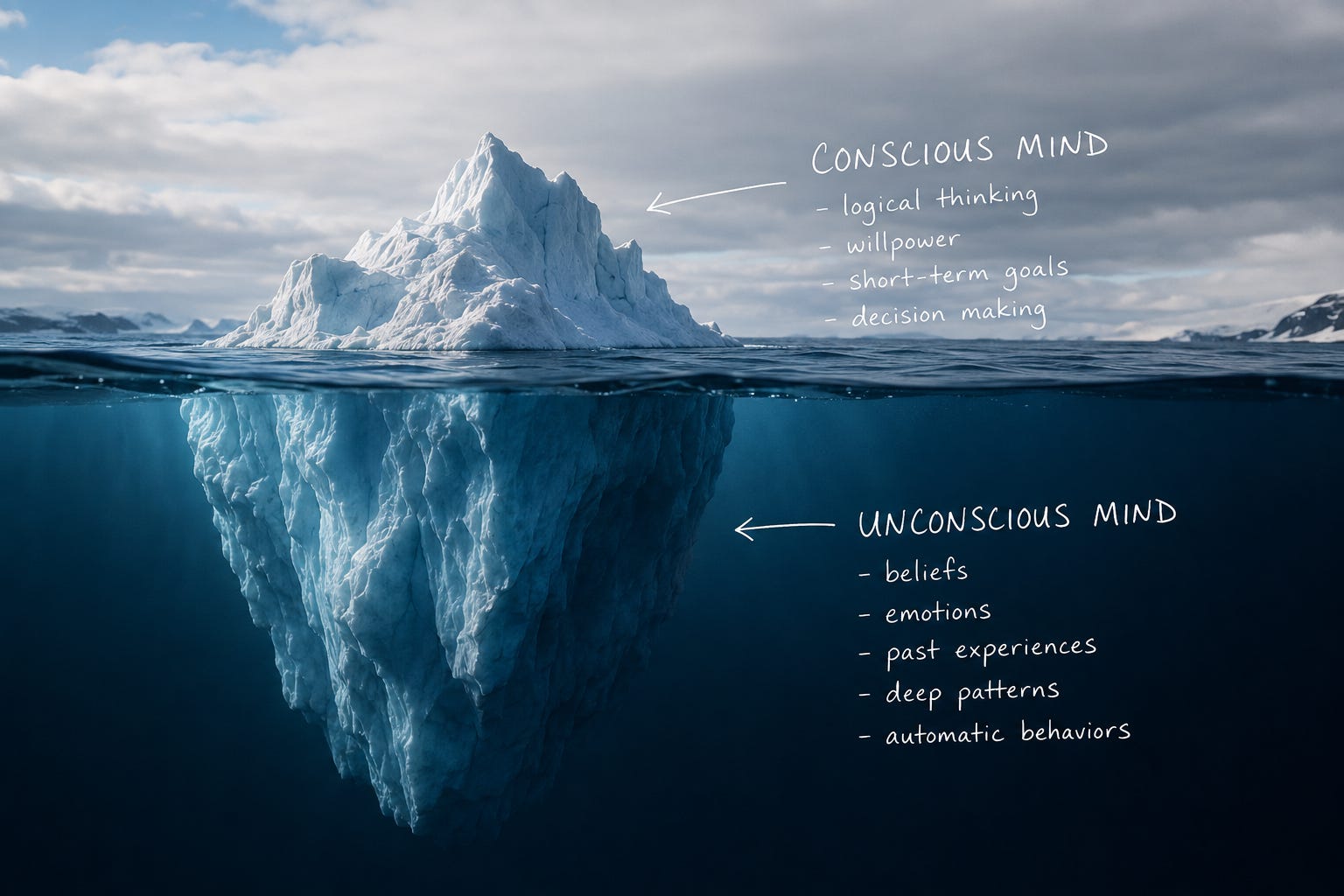
One of the most influential concepts I’ve encountered is the distinction between the conscious and unconscious mind.
Our conscious mind is where we set goals. It’s the part of us that decides we want to improve our health, build a business, repair a relationship, or become more confident. It’s logical, analytical, and future-focused.
The unconscious mind has a very different job.
Its primary concern isn’t helping us achieve our goals. Its role is to preserve what feels familiar because, from an evolutionary perspective, familiar has often meant safe.
Which means we can consciously desire one life while unconsciously organizing ourselves around another.
When I first encountered this idea through NLP, something clicked.
It explained why insight didn’t automatically create transformation.
It explained why positive thinking wasn’t always enough.
It explained why we can know exactly what to do and still find ourselves repeating the same behaviours.
Carl Jung expressed this beautifully:
“Until you make the unconscious conscious, it will direct your life and you will call it fate.”
The older I get, the more I think lasting transformation begins by becoming curious about our patterns.
I’ve stopped becoming fascinated by individual problems.
Instead, I’m fascinated by repetition.
The relationship that always ends in the same way.
The business that repeatedly reaches the same ceiling.
The financial stress that keeps returning, even when income changes.
The conflict that seems to involve different people but somehow carries the same emotional signature.
Years ago, I would have looked for a better strategy.
Today, I find myself asking a different question:
What pattern is trying to reveal itself?
One of the words I use for this is drama.
Not drama in the sense of overreacting or creating unnecessary conflict.
Drama, to me, is any repeating emotional cycle that quietly recreates itself until we’re willing to become conscious of it.
The pattern isn’t the problem.
The pattern is the invitation.
It’s pointing toward something that hasn’t yet been seen, understood, or integrated.
That’s why I’ve become less interested in helping people simply change their behaviour.
Behaviour matters.
But behaviour is often the final expression of something much deeper.
If we only work at the level of behaviour, we may create temporary change.
If we become curious about the unconscious patterns beneath the behaviour, we create the possibility for something far more lasting.

I’m still learning.
In many ways, I feel like I’ve spent the last ten years following breadcrumbs. Every certification, every teacher, every conversation with a client, and every season of my own life has expanded my understanding a little further.
None of them have offered a complete picture.
But each has revealed another layer of what it means to become someone new.
These days, I don’t believe transformation is about becoming a different person.
I think it’s about becoming conscious of the unconscious patterns that have quietly shaped the person you’ve been.
Because once you can see the pattern...
you’re no longer destined to repeat it.
You finally have the opportunity to choose something different.
Lately, I’ve found myself asking a different question.
Not, “Why can’t I change?”
But,
“What part of me still believes that staying the same is safer?”
I have a feeling that question will continue shaping both my life and my work for a long time.
totally agree with you on that 👍